Ministry of Internal Affairs and Communications improves safety with autonomous driving at Narita International Airport
At a major international airport, every movement depends on people, vehicles and communications working safely within tightly controlled space. Japan's Ministry of Internal Affairs and Communications sponsored a proof of concept at Narita International Airport to explore how autonomous driving could ease pressure from driver shortages while reducing exposure to accidents caused by human error. The demonstration combined a vehicle designed to operate inside an agreed operational design domain with remote monitoring and a redundant private 5G and carrier network system.
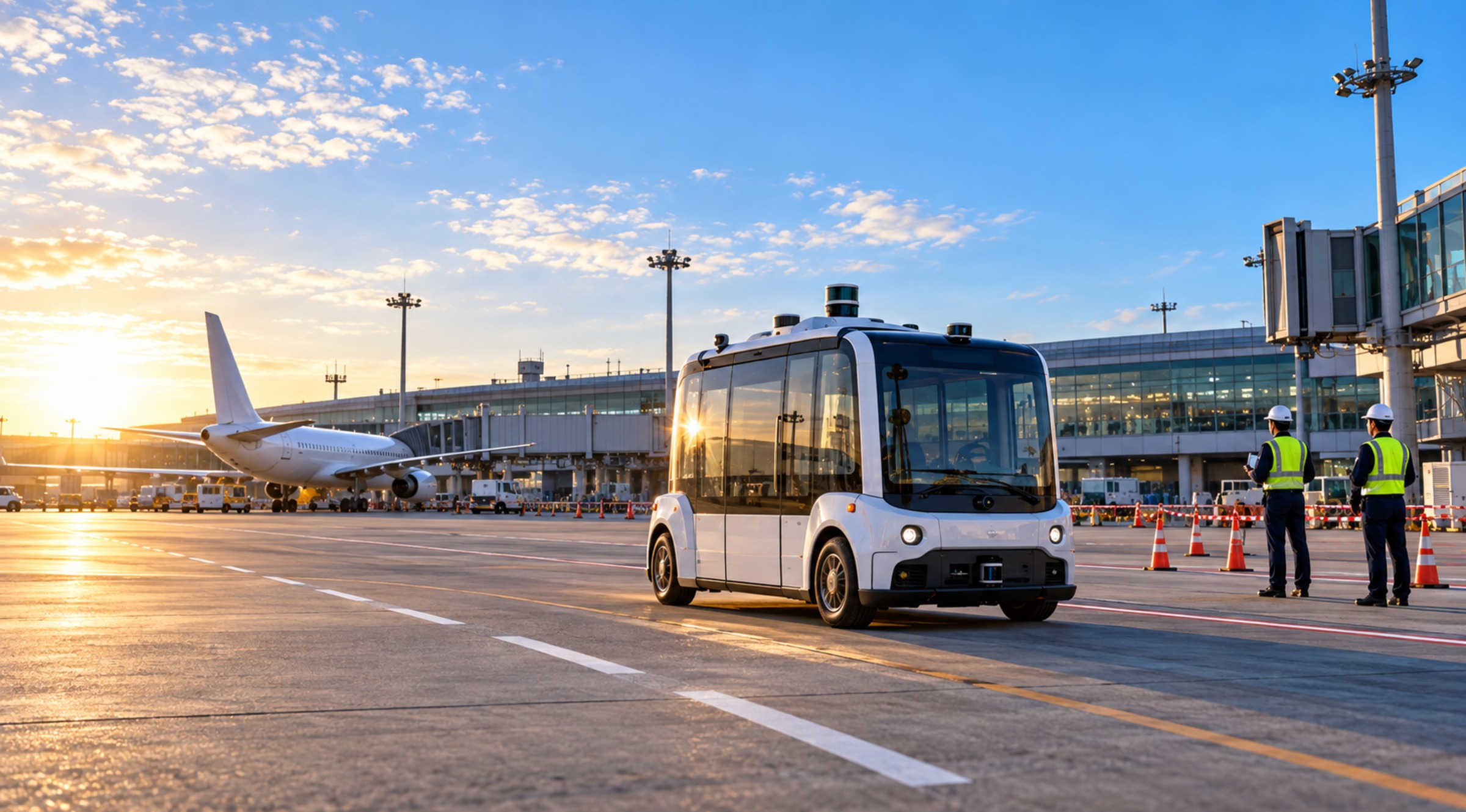
Sensor-equipped autonomous shuttle crossing a marked test route on an airport apron, with terminal buildings, an aircraft and two operations staff nearby.
Restricted-area pilot
Autonomous operation inside an agreed ODD
Dual-network resilience
Private 5G backed by carrier connectivity
Remote oversight
Autonomous vehicle monitoring included
Rulemaking evidence
Demonstration results intended to inform rules
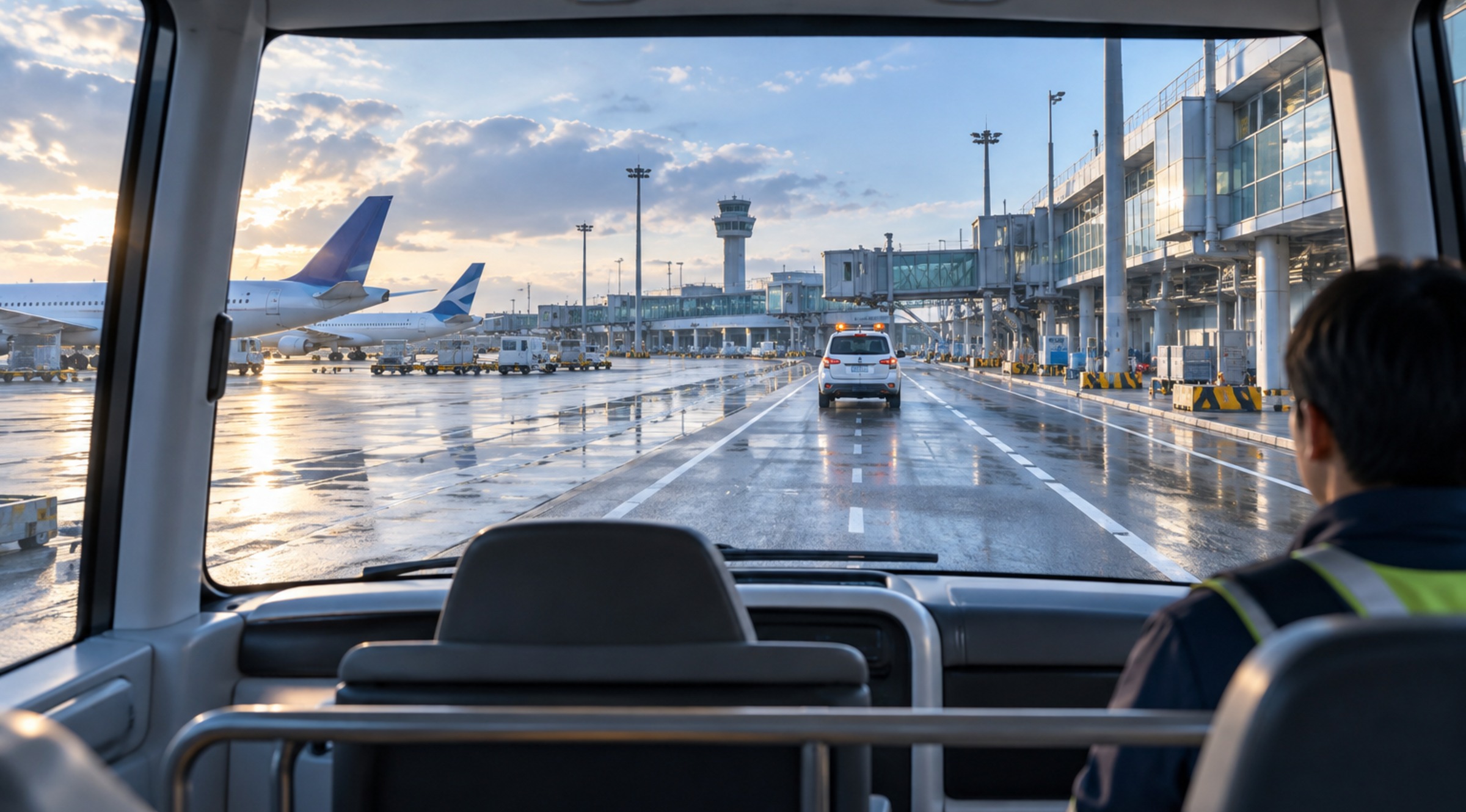
View from inside an autonomous airport shuttle following a wet service road between terminal buildings, with an airport vehicle ahead and aircraft in the distance.
Ministry of Internal Affairs and Communications (MIC) improves safety with autonomous driving at Narita International Airport

A controlled proof of concept brought together autonomous driving, an agreed operating boundary, remote monitoring and redundant communications to test a new approach to restricted-area mobility at Narita International Airport.

A safer path through airport driver shortages
Objectives
Japan's aging population and low birth rate are tightening the supply of manual labor, including the drivers airports rely on for ground transport. The initiative set out to examine whether autonomous driving could reduce that dependency while helping to minimize the risk of vehicle accidents caused by human error. At Narita, the immediate ambition was to establish the connectivity and operating conditions needed for autonomous vehicles to move without driver intervention inside a predefined, limited area agreed by vehicle developers, operators and airport managers.
Opportunity
The demonstration creates an evidence base for decisions that extend beyond a single vehicle test. Its results are intended to help shape rules for autonomous driving in restricted areas. The stated next step is to use private 5G and other technologies as part of a path toward Level 4 autonomous driving at Narita International Airport, with potential expansion to other airports. That progression remains future-facing and will depend on validated performance, operating rules and stakeholder approval.
Making autonomous mobility dependable inside a live airport

The proof of concept had to address a workforce constraint and a safety ambition while respecting the tightly defined operating conditions of a restricted airport environment.

Key Challenges
Airport operations supervisor beside a line of parked staff shuttle buses at dawn, with ground staff and terminal infrastructure in the background.
1: Driver capacity under pressure
The airport needed a credible response to a shortage of driver personnel linked to Japan's aging society and low birth rate, without assuming that automation had already delivered labor savings.
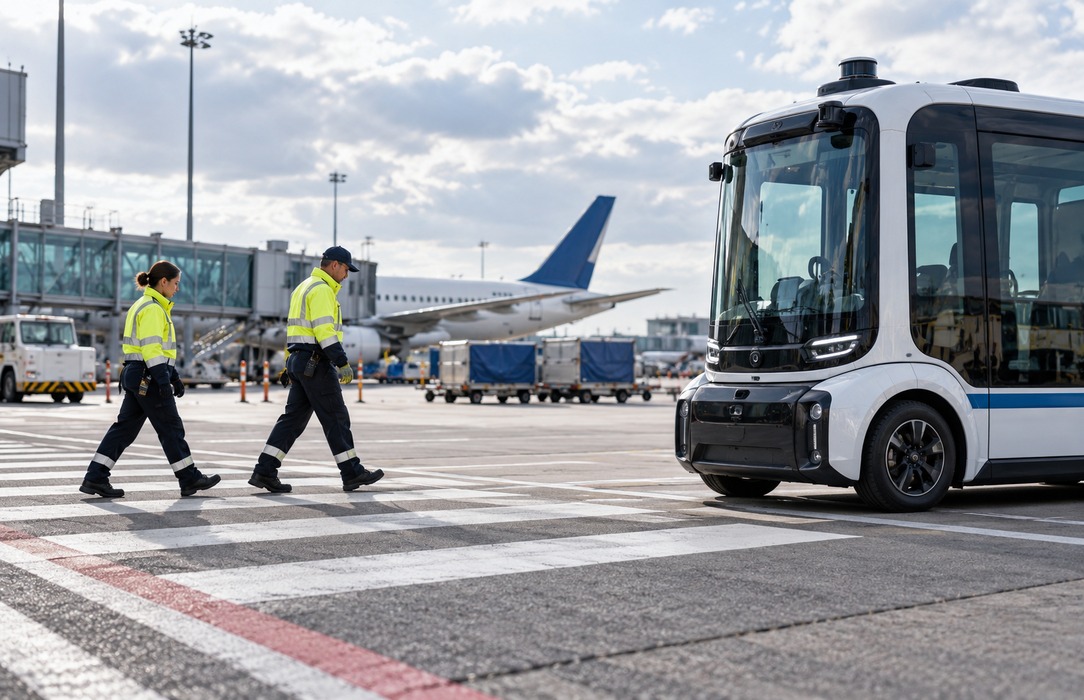
Sensor-equipped shuttle stopped at an airside crossing while two high-visibility ground crew members cross in front of terminal and aircraft operations.
2: Human-error exposure
The initiative aimed to reduce the risk of vehicle accidents caused by human error while preserving the safeguards required for ground transport in an active airport.
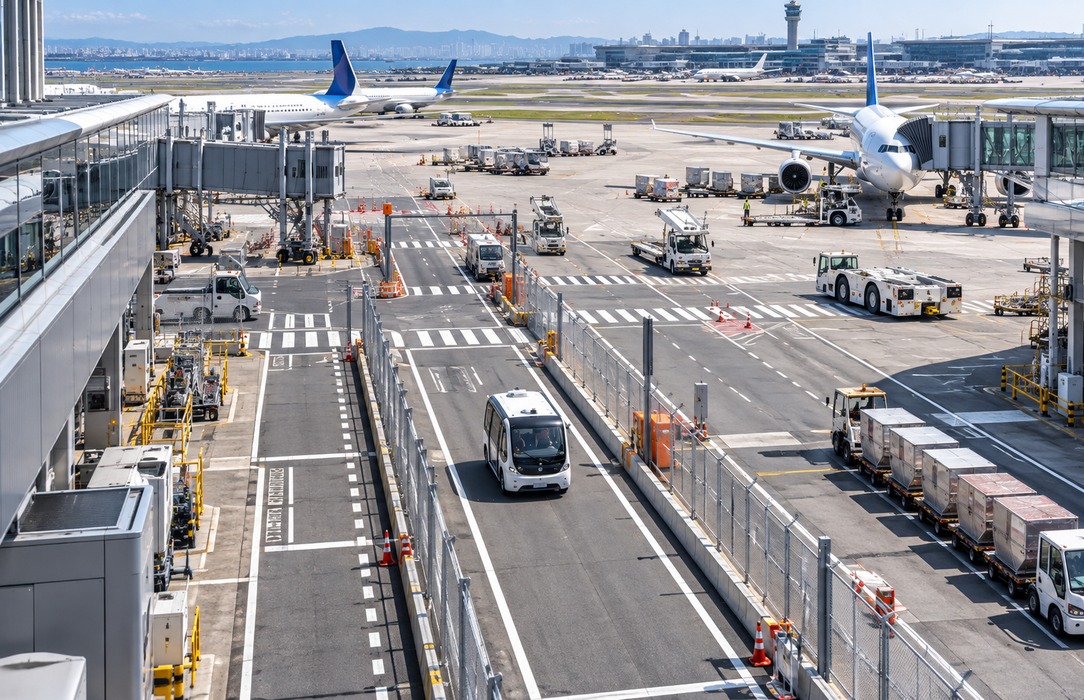
Elevated view of a fenced airport service corridor where an autonomous shuttle moves within marked lanes alongside conventional ground vehicles.
3: A tightly bounded operating domain
Autonomous operation required a predefined, limited operational design domain agreed by vehicle developers, operators and airport managers.
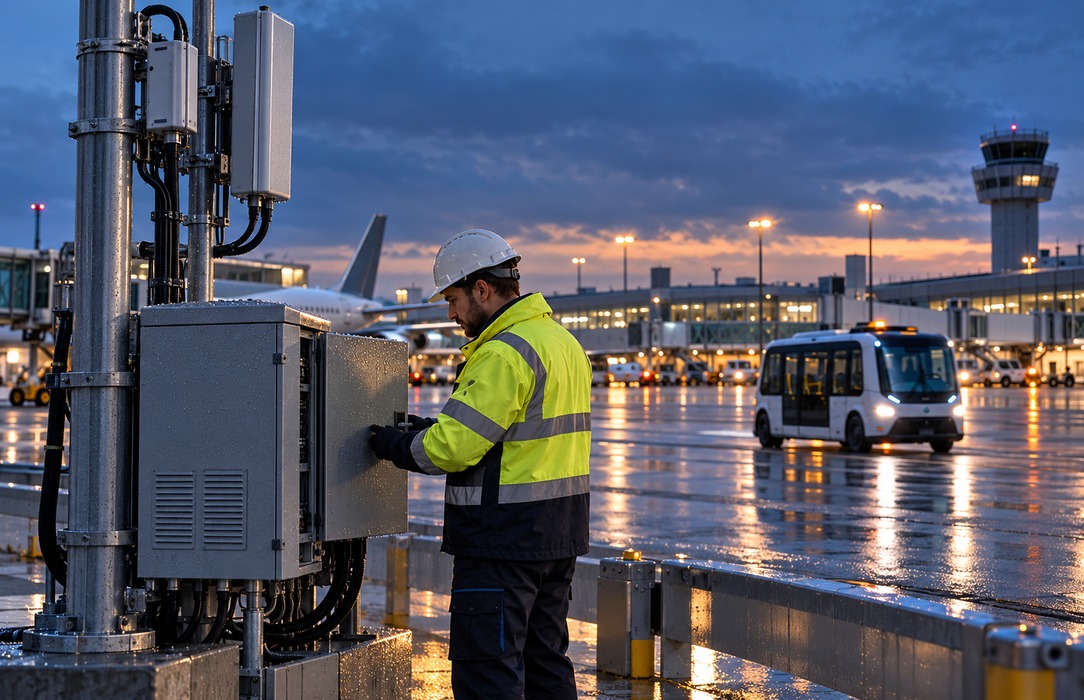
Communications engineer inspecting a private 5G small-cell installation on a wet airport apron as an autonomous shuttle operates nearby at dusk.
4: Reliable communications and oversight
The test required communications that could support autonomous movement and remote monitoring in a restricted area, including resilience across private 5G and a carrier network.
Solution
A controlled autonomous driving proof of concept supported by resilient connectivity

NTT DATA worked with the airport operator, an autonomous driving specialist and a telecommunications provider to design a proof-of-concept vehicle and the connected operating environment around it.

check icon
Autonomous vehicle demonstration

The partners designed a proof-of-concept vehicle to drive autonomously in a restricted area of Narita International Airport, directly testing an alternative to fully manual driving.

check icon
Operation without driver intervention

The system was designed to allow autonomous vehicles to operate without driver intervention inside the predefined area, addressing the initiative’s labor and human-error objectives without claiming measured results.

check icon
Stakeholder-agreed ODD

Vehicle developers, operators and airport managers agreed the operational design domain that set the boundaries for the test.

check icon
Redundant connectivity and remote monitoring

A private 5G and carrier network system provided communications redundancy, alongside remote monitoring of autonomous vehicles.

Impact
Evidence for the next phase of autonomous airport mobility

The demonstration provides a practical basis for examining autonomous driving in a restricted airport area and for informing future operating rules. It also establishes a pathway for evaluating Level 4 autonomous driving at Narita International Airport and possible replication at other airports. The source does not report measured improvements in safety, labor capacity or operating efficiency, so these outcomes should not be presented as achieved.

Drag