- All Foundries

- Commodity Management & Trading

- Customer & Marketing Strategy

- Digital Engineering

- Station Studio

- Supply Chain & Industry 5.0
- Sustainability

- Physical AI

- Next-Gen Infrastructure














Scalable & Streamlined Service Station Integration
One-off interfaces, local configurations and different vendor lifecycles slow station onboarding and make changes harder to govern. New services require repeated integration work, increasing maintenance effort and creating inconsistent data across the network. A scalable integration model uses cloud platforms, reusable APIs and common governance to connect sites without eliminating necessary local flexibility. This creates a repeatable foundation for onboarding stations, partners and services.
Standardized integration enables faster expansion, consistent operations and local flexibility across increasingly diverse station networks.

Faster and more consistent onboarding enables quicker station deployment, supporting rapid network expansion and reducing the time needed to bring new sites into full operation.
Unified processes, configurations, and governance models ensure consistent service quality across all stations, simplifying support, reducing operational complexity, and enabling efficient scaling as the network grows.
Stations can independently manage daily operations while headquarters maintains centralized standards, governance, and secure data separation, ensuring local flexibility without compromising network-wide control.
A standardized integration model minimizes custom interfaces, accelerates deployments, and makes upgrades easier to manage, allowing the network to evolve quickly without increasing technical complexity.
How NTT DATA helps
NTT DATA combines station architecture, cloud platforms, reusable integration services and governed rollout methods to connect sites, partners and services under a shared operating model.
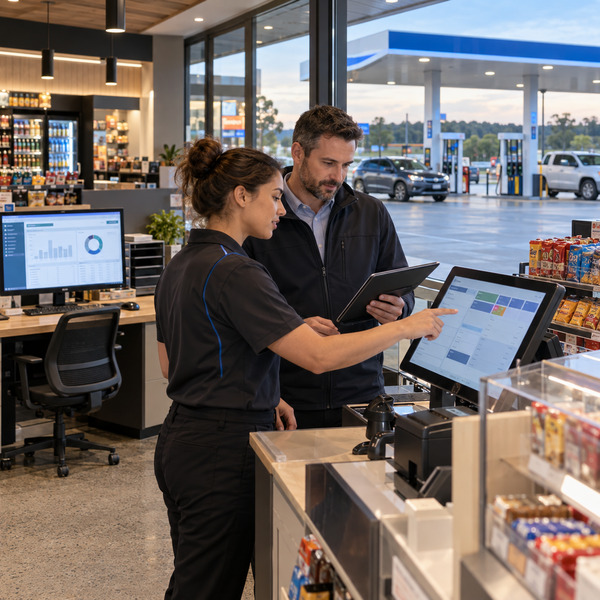
Cloud-based BOS and POS architectures standardize transaction processing, product configuration, pricing and operational reporting. Centralized platform services simplify deployment, updates and support across the network while providing stations with a consistent foundation for daily operations.

Reusable APIs and integration services connect payment platforms, loyalty systems, pricing, forecourt equipment, EV charging and third-party services. This reduces dependence on site-specific interfaces and creates a controlled way to introduce new partners and services across the network.

NTT DATA structures onboarding through reusable configuration templates, integration testing, migration controls and phased rollout plans. Governance defines which elements are standardized centrally and which can vary locally, supporting consistent deployment across station formats, partners and markets.


A standardized integration layer gives headquarters and station operators a shared foundation for onboarding sites, deploying services and managing change. Reusable interfaces, common configurations and governed rollout practices reduce reliance on one-off integrations while preserving the local flexibility required across markets, partners and station formats.
Repeatable configurations and interfaces reduce site-by-site integration effort.
Common data exchanges improve information flow across stations and headquarters.
New sites and services connect through reusable integration components.
Shared governance supports consistency while preserving approved local variation.
Create the integration foundation for faster onboarding, consistent operations and controlled deployment of new services across stations, partners and markets.