- All Foundries

- Commodity Management & Trading

- Customer & Marketing Strategy

- Digital Engineering

- Station Studio

- Supply Chain & Industry 5.0
- Sustainability

- Physical AI

- Next-Gen Infrastructure














Rail Operations Management Center
Simulation and decision-support models can help teams evaluate operational scenarios before acting. Their role, inputs, constraints and human approval points must be explicit, particularly where decisions affect safety, service continuity or passenger information. Autonomous or agentic execution should only be stated when the capability and governance model have been approved.
Support faster coordination while preserving operational control and accountability.

Consolidate approved network, service, resource and incident signals around a common operational view.
Assign ownership, connect response workflows and preserve the status of each operational action.
Compare timetable, service and resource options against defined operational constraints before execution.
Record the information, assumptions, approvals and actions associated with material operational decisions.
How NTT DATA helps
Identify the network scope, control responsibilities, escalation paths, decision rights, service priorities and interfaces between control centres and operational teams.

Connect the approved service, infrastructure, rolling-stock, resource and incident information needed for the selected operational decisions, with clear quality and access rules.

Structure detection, triage, ownership, coordination, communication, recovery and closure around defined incident types and operational procedures.

Use validated models to compare scenarios and support re-planning while keeping assumptions, constraints, approval points and human oversight visible.

Establish baselines for the selected network and incident scope, monitor operational outcomes and refine workflows according to evidence from actual service events.

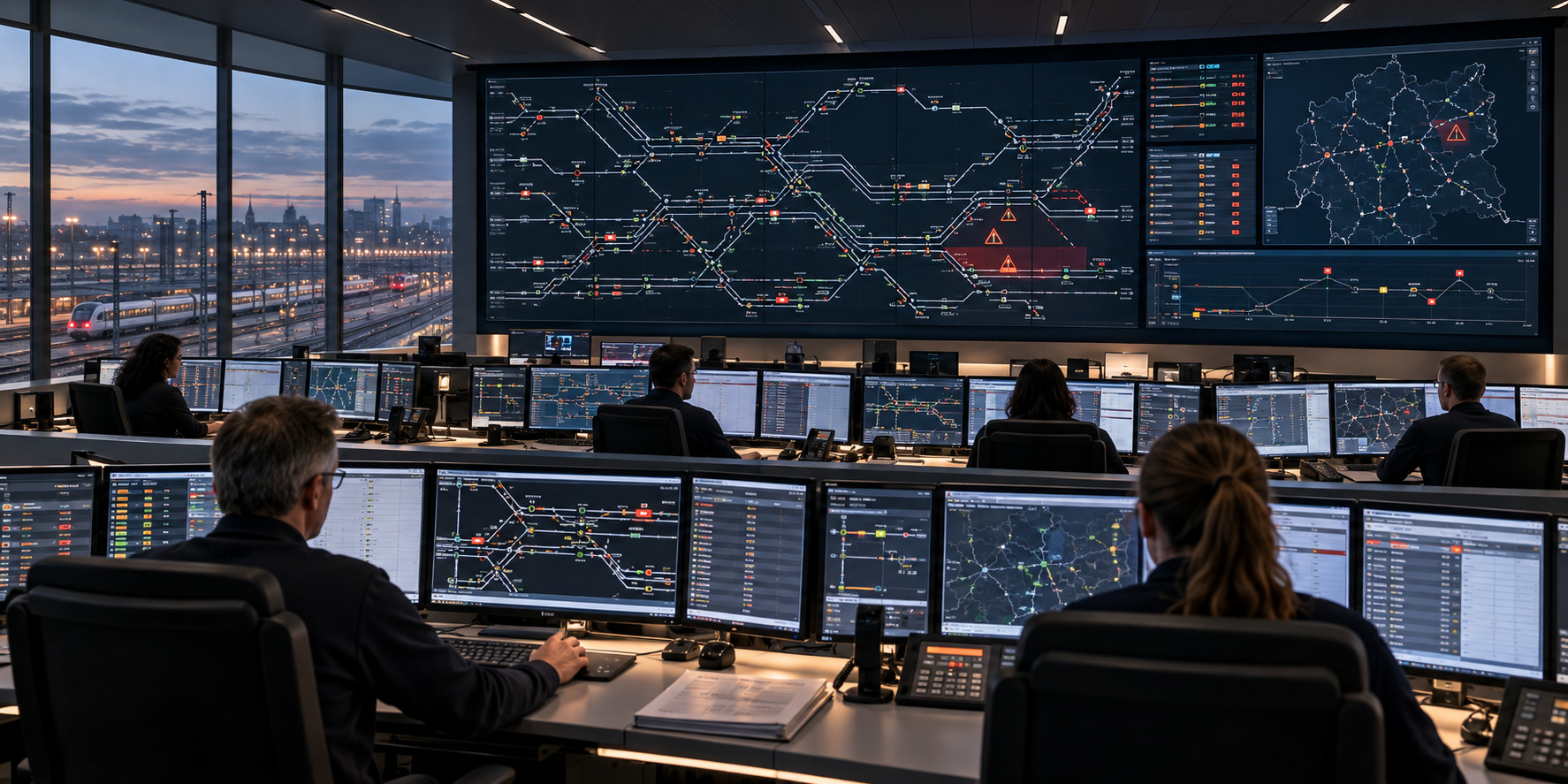
An Operations Management Center creates value when teams identify operational events earlier, coordinate decisions more consistently and restore the selected service scope with less avoidable delay. Establish the baseline, network boundary, incident categories, control responsibilities and measurement period before implementation. Measure decision quality and recovery outcomes together so a faster response does not conceal repeated incidents, incomplete actions or unmanaged operational risk.
A Rail Operations Management Center creates measurable value by helping teams detect incidents earlier, assess network impact, coordinate accountable actions and restore services against an agreed operating plan. Establish a validated baseline and scope before publishing any result.
Change in the time between a defined operational event and its verified detection within the selected control scope.
Change in the time required to assess a defined incident and approve the next accountable operational action.
Change in the time required for the selected services to return to the agreed operating state after disruption.
Change in adherence to the approved operating plan for the selected routes, services or periods.
Define a practical roadmap for a Rail Operations Management Center that connects trusted information, incident workflows, simulation and accountable re-planning across the selected operating network.