- All Foundries

- Commodity Management & Trading

- Customer & Marketing Strategy

- Digital Engineering

- Station Studio

- Supply Chain & Industry 5.0
- Sustainability

- Physical AI

- Next-Gen Infrastructure













Mining integration to actuation: close the last operational mile
Data can be reconciled. An alert generated. A meeting can align the organization. None of those changes recovery, throughput or blend unless the response reaches execution in time.
Closing the loop reduces the distance between recognizing a mining condition and changing its trajectory.

A mine can preserve blend options and redirect material before it reaches the wrong destination, while the alternative is still useful.
Process conditions can be adjusted before downstream effects become harder to reverse in recovery, throughput or inventory.
Cross-domain decisions become repeatable rather than dependent on manual follow-through and informal handoffs between teams.
The closed loop creates evidence: what was decided, what action was executed and whether the operation responded as expected.
How NTT DATA helps
Identify what can actually alter the outcome: a truck assignment, route, setpoint, sequence, field intervention or operating mode.

Make explicit the trigger, alternatives, operating constraints, authority and conditions under which the commitment can change.

Use workflow, event integration and interfaces to propagate the response into Dispatch, control, OT or field work without an informal handoff

Ensure that actuation respects interlocks, permissions, equipment states and local operating envelopes, not just a software command.

Observe whether the truck was reassigned, the setpoint changed, the field action occurred or the process trajectory moved as intended.

Capture decision and result so proven patterns can progress to recommendation, supervised execution and, where appropriate, bounded automation.

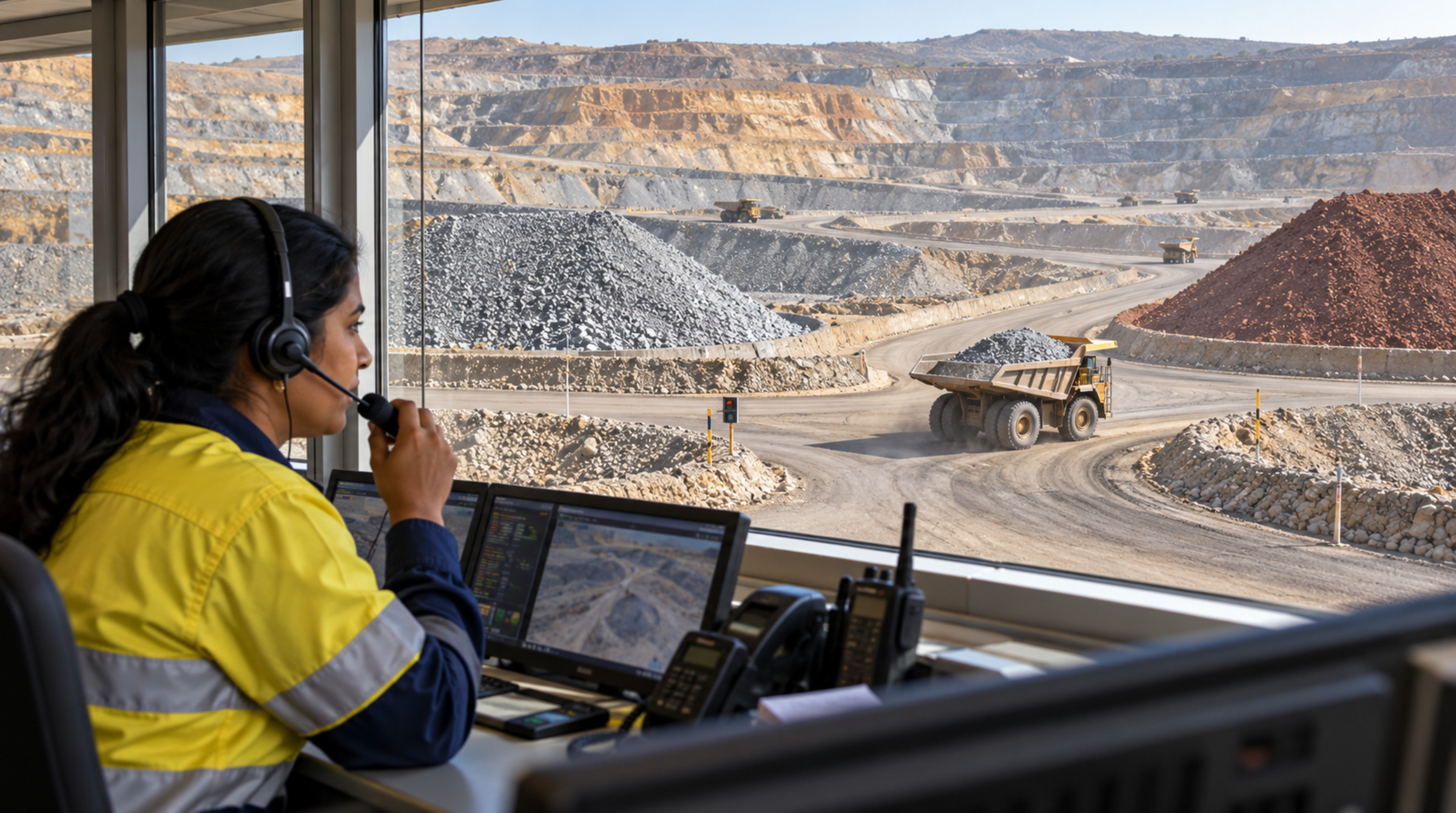
Information creates operational value when it reaches a consumer and can change execution. The effect of any specific correction remains case-specific and must be reconstructed before quantification.
The last mile is crossed when the decision becomes physical – and the operation can prove that it did.
Dispatch updates an assignment and the truck turns toward a different destination before the material reaches the wrong place.
A control system changes a setpoint, within interlocks and permitted envelopes, and the process trajectory moves as intended.
An operator executes a field action that protects the chain while alternatives still exist, instead of after the effect is fixed.
Observability confirms whether the truck was reassigned, the setpoint changed or the field action occurred exactly as decided.
Explore how connecting decisions to Dispatch, control and field execution can make integration physical across your mine.