Integrated Maritime Hub for Commercial and Logistics Excellence
A leading refining company with capacity of more than 500,000 barrels per day transformed the management of its maritime terminals into a fully integrated, intelligent hub. By unifying terminal operations into a single operating model, the company maximized asset profitability, improved operational efficiency, and enabled near real-time commercial decision-making across its value chain.
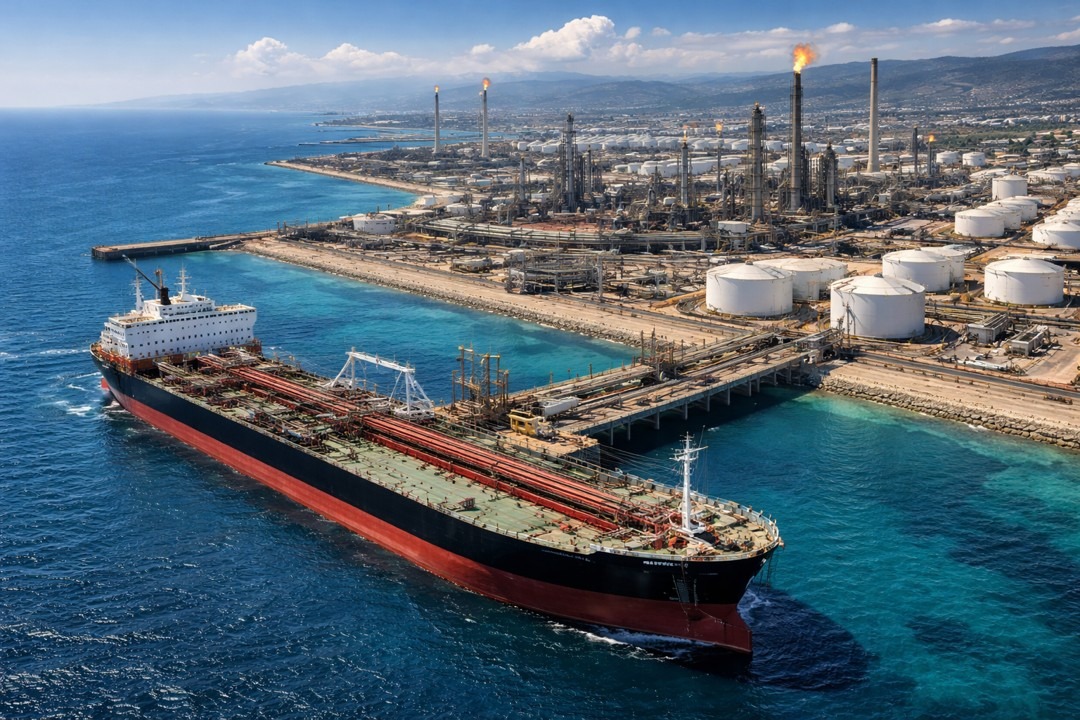
Large tanker beside a coastal refinery, with white storage tanks, pipelines, tall flare stacks, turquoise water, and mountains under a partly cloudy sky.
+ Margin
Reduction of demurrage, penalties, and inefficiencies
- CAPEX
Higher berth utilization and increased throughput
+ Efficiency
Stronger plan-to-execution alignment and commercial reliability
- Risk
Enhanced traceability, control, and regulatory compliance
Worker in a yellow safety jacket using a tablet with a process map, overlooking a blurred industrial port with cranes, containers, and warm lights at dusk.
Connecting terminals, trading and refining into a single commercial backbone
With high operational complexity and large-scale refining capacity, the company required an integrated logistics and commercial model capable of aligning crude sourcing, product trading, port operations, and refinery execution in a dynamic market environment.
Objectives
Create a single operational backbone connecting maritime terminals, trading, supply chain, tax, and refining, to maximize commercial alignment, logistics efficiency and future-ready digital scalability.
Opportunity
Terminal planning, crude supply, trading, refining, and fiscal processes traditionally operated in silos. This fragmentation limited visibility, reduced agility, and constrained margin optimization across the value chain.
Driving Digital Terminals and Commercial Integration

Proven delivery overcoming physical complexity with agile decision making

Key Challenges
Worker in a yellow safety jacket using a tablet with a process map, overlooking a blurred industrial port with cranes, containers, and warm lights at dusk.
Integrating multiple business domains, tax, trading, supply chain, terminals, and refinery, into one unified model
Man in glasses studies blue-lit data dashboards and charts on multiple monitors in a dark control room, with blurred city lights outside.
Limited consolidated visibility across port and production operations
Two workers in hard hats and reflective vests view a tablet at dusk, with brightly lit industrial towers and scaffolding blurred in the background.
Manual coordination processes increasing demurrage risks and idle times
Solution
check icon

Designed and developed the Maritime Terminals Management System and the Production Execution System for refining operations

check icon

Integrated both solutions into a unified end-to-end logistics and commercial platform and enabled native integration with accounting and energy management systems

check icon

Structured the governance and operating framework to ensure cross-departmental alignment

check icon

Established a scalable roadmap incorporating eBL, blockchain, AI, and emerging digital innovations

Impact
Safer, smarter refinery operations

•  Improved loading rack and berth utilization through integrated planning
•  Reduced idle times and demurrage costs via predictive port operation management
•  Advanced planning capabilities enabling proactive vessel scheduling and resource optimization
•  Consolidated, near real-time information shared across trading, supply chain, terminals, and refinery
•  Faster, aligned commercial decisions in response to market and operational changes
•  Enhanced margin optimization through synchronized supply, production, and trading strategies
•  A scalable digital foundation supporting the operations of the future


Drag