- All Foundries

- Commodity Management & Trading

- Customer & Marketing Strategy

- Digital Engineering

- Station Studio

- Supply Chain & Industry 5.0
- Sustainability

- Physical AI

- Next-Gen Infrastructure














AI-RAN & Open / Cloud RAN
Traditional RAN architectures concentrate technology and accountability in closed stacks. Open and cloud RAN distribute software, hardware and operations across a broader ecosystem, while AI adds new decision loops. Operators can gain choice, adaptability and capacity efficiency, but only if interoperability, performance, security and lifecycle control work as one operating model.
An open RAN becomes valuable when openness translates into operating freedom

Open interfaces and disaggregated components can widen the technology ecosystem, provided one operating model owns end to end performance.
AI can help planners and operations teams interpret radio, traffic and topology data, then recommend or automate targeted changes within governed limits.
Cloud based infrastructure, equipment consolidation and automated parameter design can reduce avoidable engineering work and improve how compute and power are used.
Operators can sequence modernization by site, workload and use case, validating interoperability and economics before scaling.
How NTT DATA helps
Assess the current RAN estate, business case, workload profile, performance thresholds, security requirements and vendor dependencies. This identifies where open, cloud or AI enabled approaches are ready to create value, and where the integration burden remains too high.

Shape the target architecture across edge and telco cloud infrastructure, accelerators, network functions, data flows and CI/CD/CT pipelines. The design links technical choices to capacity, resilience, energy and lifecycle objectives.

Onboard and test radio, distributed and centralized units, cloud platforms and management components against open interfaces. Conformance, interoperability, performance and security testing create evidence before live rollout.

Connect network data, service management and orchestration, intelligent control and AI model lifecycle management. Operations teams retain accountability while governed automation supports design, configuration, assurance and optimization.

Establish repeatable Day 0, Day 1 and Day 2 processes for rollout, observability, upgrades, incident response and continuous optimization. Skills transfer and operating model change help the network team scale the architecture, not just deploy it.
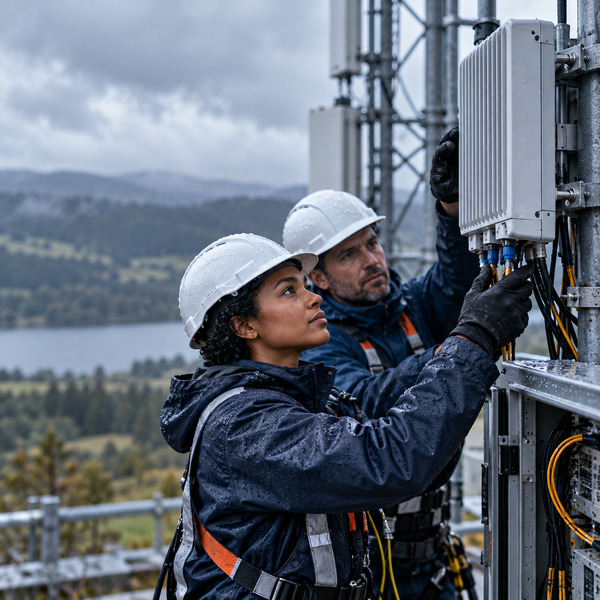

The value is becoming tangible across cost, energy, engineering effort and network performance.
A major Asian mobile operator estimates up to 30% lower total cost of ownership, up to 50% lower power consumption and up to 50% less network-design workload, enabled by infrastructure consolidation and greater automation.
In Europe, a recent lab validation reported a typical 10% to 15% improvement in uplink throughput using AI-based channel estimation with commercial 5G RAN software, with field validation as the next step.
Evaluate total cost across infrastructure, integration, testing, operations, upgrades and energy, rather than focusing on component price alone.
Reduce manual design and configuration work through reusable pipelines, automated validation and policy led orchestration.
Use workload placement, equipment consolidation and intelligent control to manage power consumption without compromising coverage or service quality.
Prove AI-assisted gains against defined radio conditions and operational baselines before moving from the lab into scaled deployment.
Start the conversation that connects architecture choices to measurable operator value.