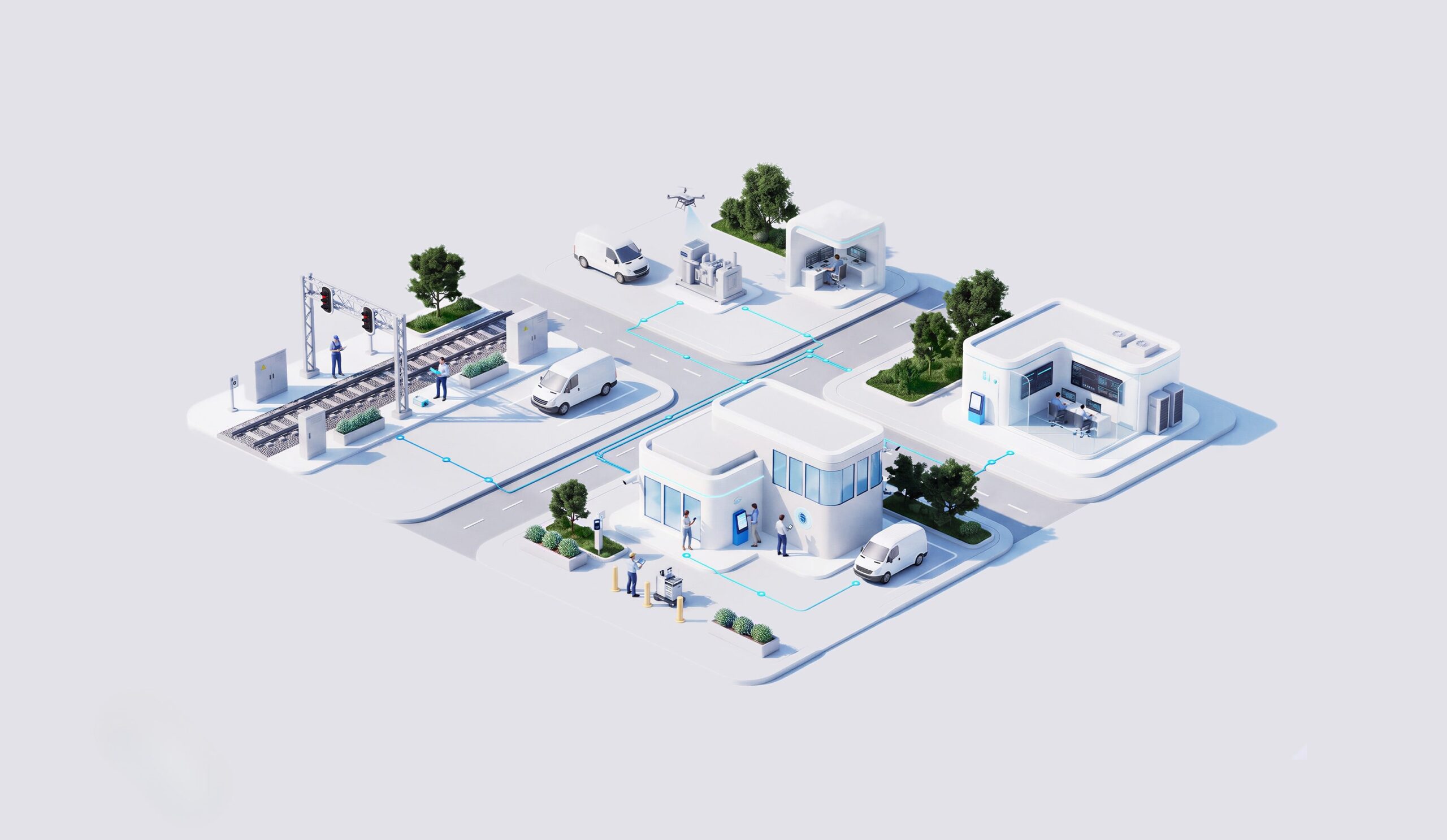
Normalized hierarchy from unit to CML, damage mechanisms, quantified PoF and CoF [1][2][3].
3D models, P&IDs, historians, and IT/OT semantics converge in a unified asset model [7].
Engineering and maintenance share consistent asset context.

For decades, heavy industrial organizations across refining, petrochemicals, upstream oil and gas, and power generation have treated Risk-Based Inspection (RBI) primarily as a compliance study. It helps extend inspection intervals on low-risk equipment and directs limited turnaround budgets toward high-consequence units [1][2]. That value remains important, but a periodic study leaves a broader architectural opportunity unused.
A well-executed RBI program, especially when combined with Integrity Operating Windows (IOWs) under API RP 584 [4], creates a governed data architecture for the physical asset. It enforces asset hierarchies, codifies damage mechanisms under API RP 571 [3], establishes operating limits derived from process chemistry, and traces field evidence to specific equipment components [6].
NTT DATA proposes extending this foundation across the asset lifecycle. Connecting RBI and IOWs with Digital Engineering, Process Digital Twins, Industrial AI, Enterprise Asset Management (EAM), and Field Service Management (FSM) can turn an isolated calculation into a continuous, closed-loop operating model [5][7][8].
Normalized hierarchy from unit to CML, damage mechanisms, quantified PoF and CoF [1][2][3].
3D models, P&IDs, historians, and IT/OT semantics converge in a unified asset model [7].
Engineering and maintenance share consistent asset context.
Critical, Standard, and Informational limits govern chemistry and process variables [4].
First-principles simulation explains excursions and supports what-if scenarios.
Teams can move from threshold violation toward root-cause mitigation and operational adjustment.
Calendar turnarounds and historical corrosion rates drive periodic recalibration [1].
Events update risk, create EAM work orders, and connect to mobile execution [5][8].
Lower decision latency supports pre-emptive intervention and auditable compliance [10].
The proposed reference architecture treats API RP 580/581 [1][2], API RP 571 [3], and API RP 584 [4] as its engineering foundation. Digital components extend those principles rather than replace them.
Risk scoring requires a strict hierarchy from site and process system to corrosion circuits, equipment, piping segments, components, and Corrosion Monitoring Locations (CMLs). Each component maps to active damage mechanisms under API RP 571 [1][2][3].
RBI and IOWs combine physical location, operating context, metallurgical limits, and inspection history in a governed semantic layer. Predictive models can then operate against verified asset physics [6].
IOWs define the operating envelope for mechanical integrity, including temperature, partial pressure, pH, chloride content, H₂S concentration, free water, flow velocity, and thermal cycling. Their three threshold categories turn raw alarms into integrity-relevant events [4].
Operational events, Management of Change procedures, and new thickness measurements can continuously recalibrate Probability of Failure (PoF) and Consequence of Failure (CoF), instead of waiting for the next three-to-five-year study [1][4].
A connected Asset Performance Management architecture combines historian tags, laboratory analysis, damage libraries, and risk models, then translates integrity events into prioritized work orders in systems such as SAP PM and IBM Maximo [5][7].
Automation can handle corrosion rates, remaining-life projections, interval scheduling, and threshold monitoring. Engineers retain accountability for interpretation, API 579-1/ASME FFS-1 assessments, and validation of safety-critical interventions [11].
Three-to-five-year static studies satisfy baseline mechanical-integrity audits [1][10], but mid-cycle process excursions may remain invisible until turnarounds.
Historian dashboards and standalone anomaly detectors flag deviations without API 571/584 metallurgical context or EAM integration, adding alarms and manual handoffs.
Governed taxonomies, real-time IOWs, thermodynamic twins, and human-governed enterprise workflows translate excursions into verified field action [4][6][7][8].
An IOW detects a limit breach but does not explain its cause. Thermodynamic Process Digital Twins can estimate unmeasured parameters and test operational adjustments, such as reflux changes or neutralizer dosing, while throughput targets remain visible [7].
The proposed Dynamic Asset Health framework combines Risk (PoF × CoF), Exposure (cumulative IOW deviations), Current Condition (CML thickness), and Forecast (predictive degradation curves) [5][7].
A semantic digital thread aligns P&IDs, laser scans, historian tags, RBI CMLs, and EAM functional locations across Design, Build, Operate, Inspect, Maintain, Modify, and Learn.
Agents can retrieve records, cross-reference damage mechanisms, trigger simulations, and draft work packages. A certified inspection engineer retains safety-critical review and sign-off [5][8].
The proposed pipeline connects plant telemetry to verified field execution, then returns the evidence to the baseline model [6].
Collect the variables each IOW requires, at the cadence each damage mechanism demands. Measurement gaps are flagged, and every value carries a data-quality status to support decissions.
Where valid data is available, flag Critical, Standard, or Informational excursions and track their duration and cumulative exposure [4].
Estimate kinetic degradation and cumulative exposure for affected CMLs [3].
When reassessment criteria are met, a qualified integrity engineer updates the RBI model; every change to the risk model is versioned and traceable [1][2].
Generate prioritized work orders, NDT techniques, and inspection scopes [5].
Return measurements, photos, applied technique, coverage, and findings to feed the baseline model, closing the loop [8].
NTT DATA proposes a reference architecture assembled from verified building blocks in Digital Engineering, Operational Digital Twins, OT/IT Data Fabrics, APM/EAM integration, Connected Worker Field Services, and Physical and Agentic AI [7][8]. It is a systems-integration proposition across Operational Technology, Information Technology, and Engineering Technology, not a single pre-packaged software product.
P&IDs, 3D BIM, design envelopes, and MOC logs.
OT historians, SCADA, real-time IOW monitoring, and Process Twins.
API 580/581 models, damage mechanism libraries, and predictive AI.
APM core, dynamic risk calculation, and Agentic AI governance.
EAM and SAP PM, work orders, planning, and spares.
FSM, ruggedized mobile devices, and digital NDT logs.
Automated evergreening and design-basis updates.
| Capability | Role | Representative scope | Connection to RBI and IOWs |
|---|---|---|---|
| 1. Digital Engineering | Authoritative asset baseline | Hierarchy, 3D scans, smart P&IDs, design basis, MOC | Canonical context for integrity events |
| 2. Process Digital Twins | First-principles modeling | Thermodynamics, what-if tuning, boundary prediction | Root-cause mitigation and adjustment |
| 3. Industrial Data Fabric | Contextual semantic layer | Historians, OT/IT convergence, OPC UA, time series | Sensor data bound to equipment and circuits |
| 4. Asset Integrity | Risk and failure logic | API 580/581, API 571 libraries, API RP 584 limits | Governing intelligence for consequence and inspection |
| 5. Predictive AI and APM | Degradation forecasting | Anomaly detection, RUL models, health scoring | Dynamic condition supplements static intervals |
| 6. Enterprise Asset Management | Controlled maintenance | SAP PM/S/4HANA, Maximo, planning, procurement | Recommendations become auditable work orders |
| 7. Field Service Management | Physical execution | Mobile apps, NDT forms, photos, RFID or barcode | Verified field data returns to the twin |
| 8. Agentic Orchestration | Cross-stack coordination | Agents, event monitoring, retrieval, human review | Lower latency from alarm to approved execution |
In an illustrative refinery scenario, sulfur content in the reactor inslet stream spikes. H₂S concentration and operating temperature breach IOW limits in reactor effluent piping [4]. The workflow then progresses through connected engineering and enterprise systems.
The OT historian flags a Critical IOW Excursion.
The asset hierarchy identifies the affected carbon-steel circuit and its API RP 571 corrosion susceptibility [3].
The Process Twin estimates ammonium bisulfide deposition risk under the elevated operating profile [7].
The APM engine updates PoF and moves the circuit from Medium to High risk [2].
An engineer reviews ultrasonic thickness gauging at six CMLs before the planner approves the SAP PM order and FSM dispatch [8].
Field readings confirm wall loss within fitness-for-service tolerances [11]. The workflow updates remaining life and the audit record [10].
The planning ranges below draw on industrial digital-transformation benchmarks. They are indicative, not guaranteed single-site outcomes. Realized value depends on taxonomy quality, sensor coverage, turnaround scope, and operating discipline.
| Value lever | Operational driver | Indicative impact |
|---|---|---|
| Risk Mitigation | Real-time metallurgical threshold detection | Supports reduction in Tier 1 and Tier 2 Process Safety Events [9]. |
| Reliability and Uptime | Risk, exposure, condition, and degradation forecasts | 1–3% production performance gains reported in operational twin deployments [7]; indicative 10–25% reduction in unplanned deferrals. |
| Inspection Efficiency | Event-driven evergreening | Indicative 15–30% optimization in turnaround inspection scope and spend [1][2]. |
| Maintenance Productivity | Pre-populated, risk-prioritized work orders | Indicative 20–35% reduction in planner-to-field handoff latency [8]. |
| Engineering Capacity | Automated calculations and reporting | Senior engineers can focus on API 579-1/ASME FFS-1 assessments and critical decisions [11]. |
| Data Fabric Capitalization | Governed semantic digital thread | Reusable context for debottlenecking, revamps, and ISO 55001 lifecycle management [5][7]. |
| Auditability and Traceability | Connected alarms, simulations, approvals, and NDT logs | Digital evidence for mechanical-integrity, MOC, and insurer reviews [10]. |
| Workforce Knowledge Capture | Governed metallurgical and inspection rules | Repeatable workflows can mitigate retirement-driven expertise loss [6][8]. |
Reconcile hierarchies, equipment tags, and CML identifiers across P&IDs, historians, and SAP PM or Maximo.
Define Critical, Standard, and Informational boundaries and map them to documented API RP 571 damage mechanisms [3][4].
Tie recalculation to cumulative IOW excursions, new thickness data, and Management of Change events [1][4].
Connect APM and EAM to field devices so approved recommendations become verified work [8].
Let agents retrieve context and prepare work scopes while certified engineers retain safety-critical sign-off [5][8].
Can our systems trace a high-consequence corrosion circuit from smart P&ID to historian tag, RBI model, and EAM location without manual spreadsheet translation?
After a critical API RP 584 breach, how long passes before cumulative damage reaches PoF curves and field inspection scopes?
Do digital twins and AI use segmented read-only OT ingestion with mandatory certified-engineer sign-off?
How much inspection spend still follows fixed calendar conventions instead of risk exposure and verified condition?
Closing the integrity loop is a prerequisite for autonomous operations. Process optimization alone is insufficient because the control architecture must also understand metallurgical limits, equipment degradation, and maintenance constraints.
Authoritative engineering standards, regulatory frameworks, and industry sources listed in the supplied document. The source records an access date of 2 November 2026.
[1] American Petroleum Institute. API Recommended Practice 580: Risk-Based Inspection, 4th edition, July 2023.
[2] American Petroleum Institute. API Recommended Practice 581: Risk-Based Inspection Methodology, 4th edition, January 2025.
[3] American Petroleum Institute. API Recommended Practice 571: Damage Mechanisms Affecting Fixed Equipment in the Refining Industry, 3rd edition, March 2020. The source notes 67 damage mechanisms in Sections 3.1–3.67.
[4] American Petroleum Institute. API Recommended Practice 584: Integrity Operating Windows, 2nd edition, December 2021.
[5] International Organization for Standardization. ISO 55001:2024, Asset management system requirements, 2nd edition, July 2024.
[6] Ramos Macías, Leonardo. RBI + IOWs. De la optimización de inspecciones a su valor como arquitectura de datos. Industry Technical Perspective, 18 October 2026.
[7] NTT DATA BizTalks. Digital Asset Management for Advanced O&M and The Operational Twin: Where Data Drives the Plant, 2026.
[8] NTT DATA BizTalks. The Autonomous Refinery Playbook: From Vision to Value, Digital Field Services Transformation, and Physical AI Foundry, 2026.
[9] American Petroleum Institute. API Recommended Practice 754: Process Safety Performance Indicators for the Refining and Petrochemical Industries, 4th edition, August 2026.
[10] Occupational Safety and Health Administration. 29 CFR 1910.119: Process Safety Management of Highly Hazardous Chemicals.
[11] American Petroleum Institute and American Society of Mechanical Engineers. API 579-1 / ASME FFS-1: Fitness-For-Service, 4th edition, December 2021.
The practical test is whether an operating excursion can move through engineering context, risk reassessment, governed approval, and field evidence without losing identity or accountability.